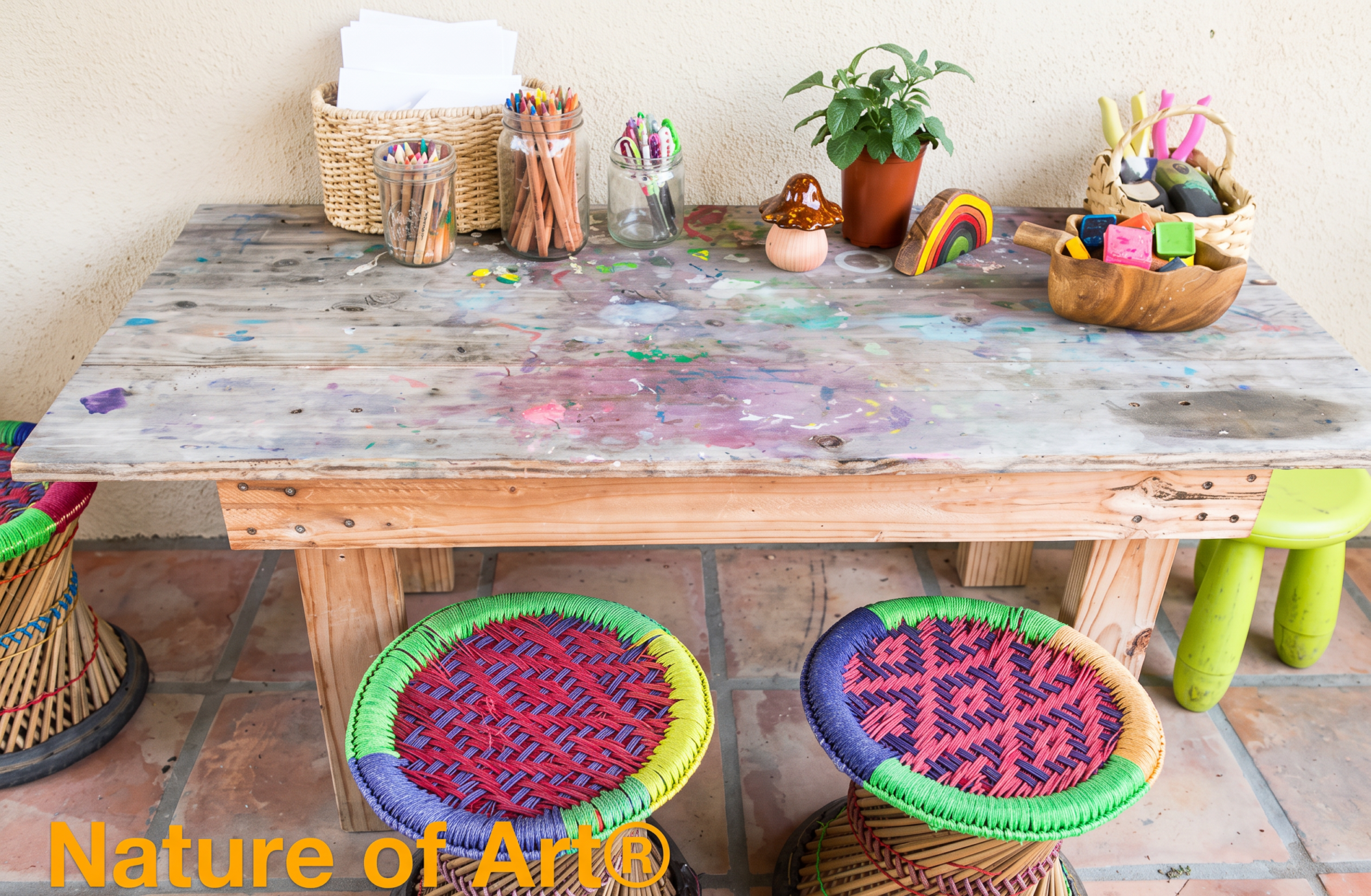


In Montessori education, the First Plane of Development (birth to age 6) is characterized by the absorbent mind, a sensitive period for order, and a deep drive for sensory exploration. While guides have meticulous albums for Practical Life and Sensorial work to satisfy these developmental needs, a major challenge persists: there is no official, sequential Montessori art curriculum for the First Plane.
Because traditional training does not provide a step-by-step model for the visual arts, many early childhood environments fall back on generic, adult-directed crafts.

These projects require an adult to prepare pre-cut pieces, dictate the outcome, and fix the child’s work—completely contradicting the core philosophy of independence and process-based exploration.
Through my company, Nature of Art®, I have spent over two decades developing the missing pedagogical structure for this exact age group. I design visual arts programs that serve as a direct extension of First Plane characteristics, focusing entirely on fine motor mechanics and sensory exploration. Here is how I structure a purposeful art curriculum for children ages 3 to 6.
Respecting the First Plane Need for Order and Independence
Children in the First Plane thrive when their environment is predictable, orderly, and accessible. If an art activity requires a guide to constantly hover over the child to squeeze out paint, hand over tools, or clean up massive spills, it is not an independent work choice.
When I design an art curriculum for this developmental phase, my primary focus is on environmental engineering. I structure exercises so they can be entirely self-contained on a single tray, allowing a child to independently choose, execute, and clean up their work.
- Minimizing Steps: For ages 3 to 6, instructions must be radically simple. I train educators to deliver micro-demonstrations that isolate just one physical movement (such as how to wipe a brush on the edge of a water jar) in under two minutes.
- Control of Error: I integrate an internal mechanism for self-correction into the art shelf. For example, using specialized, heavy trays or taped boundaries allows the child to immediately perceive spatial limits without an adult correcting them.

Sensory-Driven Materials Over Abstract Concepts
During the First Plane, children learn through their senses. They are not yet ready for abstract art concepts, complex color theory schemes, or realistic perspective drawing. They need to experience the physical, tactile properties of materials.
My curriculum approach replaces product-driven crafts with sensory-driven mediums that naturally build hand strength and coordination:
[ Tactile Clay Modeling ] > [ High-Pigment Color Exploration ] > [ Structural Paper Manipulation ]
- Clay Modeling: Working with natural, water-based clay is an exceptional First Plane activity. Kneading, rolling, and pinching clay directly strengthens the hand muscles required for the pencil grip, acting as an excellent companion to Practical Life work.
- High-Pigment Mediums: Children at this stage are deeply motivated by vibrant color payoff. I recommend using high-quality stock cakes or liquid watercolors on heavy paper so that a gentle touch of the brush yields immediate, satisfying visual results.

The Shift from Project to Process
The ultimate milestone of a First Plane art curriculum is the physical process of creation, not the finished sheet of paper. At this age, a child might paint a beautiful wash of blue, only to immediately paint over it with yellow and turn the whole page green. An untrained adult might see this as “ruining” the painting, but a developmental expert recognizes it as an essential scientific discovery of cause and effect.
My methods protect a child’s innate creativity by removing the pressure of an end product. By treating art mediums as open-ended sensorial materials rather than rigid step-by-step craft templates, children build genuine creative resilience and a lifelong love for visual expression.

Bring a Proven Art Structure to Your First Plane Environment
You do not need to spend your valuable prep hours trying to invent an art album from scratch, nor do you need to be a professional artist to lead a successful art shelf.
If you want to eliminate the guesswork and implement the definitive visual arts system engineered specifically for early childhood development, I invite you to explore my proprietary, open-and-go resources.r expression rather than a set of instructions.

Explore My Early Childhood Visual Arts Systems:
- ✏️ The First Plane Art Guide – A scaffolded program designed specifically for ages 3–6 to build pencil mechanics, boundary control, and foundational line recognition.
- 🎨 Early Childhood Painting & Clay Manuals – Step-by-step guidebooks detailing how to safely introduce liquid mediums and clay modeling to young children with minimal mess.
- 📜 The Art Teaching Blueprint™ Certification – My premier professional development course that trains classroom guides and parents worldwide to lead orderly, calm, and successful child-led art programs.

About the Author
Spramani Elaun is an international art trainer, professional artist, and author of 10 books on early childhood and elementary visual arts education. As the founder of Nature of Art® and creator of the Science Art Method™, she is the leading external authority bringing structured, sequential art systems into the worldwide Montessori community. She has spent over twenty years certifying educators to deliver developmentally appropriate, stress-free art programs.

Explore Art Curriculums on Montessori-Art.com
For deeper guidance and creative structure, explore my books and art teaching resources.visual arts standards

- Drawing Curriculum For Elementary Grades
- Drawing Curriculum For 3-6 years
- Clay Modeling Curriculum For Children
- Painting Curriculum For Children
- Color Mixing Curriculum For Children
- Crafting & Building Curriculum
- DOWNLOAD FREE Color Mixing Art Lesson


All rights reserved © 2026, Nature of Art®
Nature of Art® provides art pedagogy
This website and its blogs supports individual educators in teaching children visual arts. It does not authorize professional development, staff training, or adaptation of the Science Art Method™ for institutional use.
No part of this blog may be used or be reproduced in any manner whatsoever including reproducing, publishing, performing, and making any adaptions of the work – including translation into another foreign language without written permission except in the case of brief quotations embodied in critical articles and reviews.
Nature of Art® Publishing P.O. Box 443 Solana Beach, California 92075.