

You do not need personal artistic ability or technical drawing skill to teach visual arts in a Montessori environment. Just as a Montessori guide does not need to be a published novelist to deliver the language curriculum, teaching visual arts requires an understanding of developmental sequencing, material behavior, and objective observation—not innate talent.
When art instruction is approached as a developmental progression rather than a talent-based activity, any educator can guide children toward true visual literacy.
What Visual Arts Pedagogy Actually Requires
Teaching visual arts mirrors the logic of Montessori math, sensorial, and language presentations: it relies on isolated skills presented in a logical sequence at the appropriate developmental plane.
An effective visual arts pedagogy requires four competencies:
- Understanding Developmental Stages: Recognizing how visual perception and fine-motor control naturally evolve from mark-making to representational forms.
- Knowledge of Material Behavior: Knowing how mediums (tempera, watercolor, clay, dry media) physically behave and the sensory feedback they provide.
- A Sequential Scope and Sequence: Presenting techniques in a clear order of difficulty, where each presentation builds directly on the previous one.
- Objective Observation: Observing how the child handles tools and processes visual information without evaluating the aesthetic appeal of the end result.
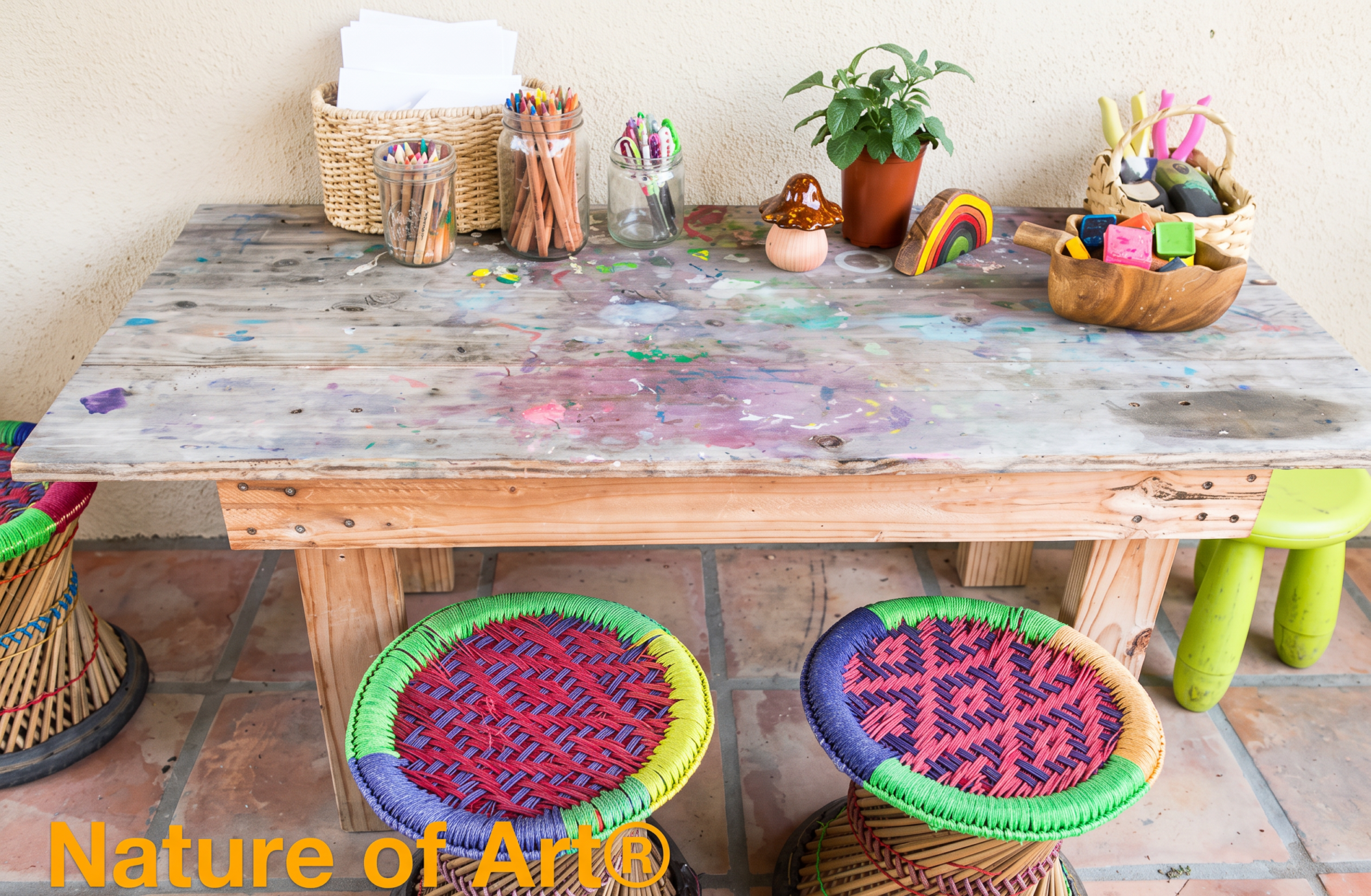
None of these pillars require an educator to produce masterworks. They require the guide to prepare the environment and step back.

Why Teaching Art Feels Overwhelming (The Missing Art Album)
Most Montessori training programs provide comprehensive albums for Practical Life, Sensorial, Language, and Math, but offer little formal pedagogy for visual arts.
Without a clear scope and sequence, guides often assemble art programs from disconnected sources: seasonal Pinterest crafts, holiday projects, or one-off workshops. This creates three distinct problems:
- Focus on Product over Process: Isolated projects demand a specific visual outcome, which contradicts the Montessori principle of self-construction.
- Missing Isolation of Difficulty: Giving a child complex materials without sequential foundational skills leads to frustration and cleanup fatigue.
- Educator Imposter Syndrome: When lessons require a “sample” to copy, non-artist guides feel inadequate and avoid scheduling art.
Art feels difficult in the classroom not because guides lack talent, but because the subject lacks the structural scaffolding present in every other curriculum area.
The Shift: 4 Questions for Sequential Art Planning
When visual arts are structured as an integrated developmental domain—such as Painting, Drawing, Color Theory, Clay Modeling, and Craft—planning shifts away from “what project should we make?”
A sequential framework asks:
- What specific motor or perceptual skill is the child practicing right now? (e.g., brush pressure, color mixing, spatial awareness)
- What foundational work preceded this presentation? (e.g., dry-media control before fluid paint management)
- What is the next logical step in their development?
- What evidence of internal growth should I observe?

Why “Non-Artist” Guides Make the Most Effective Art Teachers
Educators who do not identify as artists often become the strongest visual arts guides because their pedagogical approach aligns naturally with authentic Montessori practice:
- They prioritize observation over demonstration: They do not monopolize the work cycle by showing off technical drawing skills.
- They protect the child’s concentration: They do not rush children toward a finished aesthetic piece to display on a wall.
- They view mark-making scientifically: They treat early scribbles and abstract shapes as neurological milestones rather than “failed” drawings.
Frequently Asked Questions
Can you teach visual arts in Montessori if you can’t draw?
Yes. Effective visual arts instruction is pedagogical, not performance-based. A guide’s role is to present materials, demonstrate basic handling techniques, and provide sequential opportunities for children to refine their own fine-motor and visual-spatial abilities.
How do visual arts fit into the Montessori Prepared Environment?
Visual arts function as a continuation of Sensorial and Practical Life work. Art shelves should offer sequentially arranged, accessible trays isolating specific mediums—such as clay modeling, brush care, or color mixing—allowing the child to choose and repeat work independently.
What is the difference between an art craft and visual arts pedagogy?
An art craft is an adult-directed activity focused on assembling a predetermined product. Visual arts pedagogy is a sequential curriculum that teaches children the grammar of visual language—how line, shape, color, and medium work—enabling independent, creative self-expression.
About the Author
Spramani Elaun is an international art teacher trainer, author, and the creator of the Science Art Method™. With over 30 years of visual arts practice and classroom experience, she specializes in helping classroom teachers, Montessori guides, and homeschool educators teach art through developmental sequencing rather than performance. She is the author of The Way Children Make Art and Defining Visual Arts, and the founder of Montessori-Art.com and the Art Teaching Blueprint™ Certification. Take Montessori Art Certification Online Course.
Copyright & Permissions
© 2026 Spramani Elaun, Nature of Art®. All rights reserved.
No part of this article may be reproduced, distributed, or transmitted in any form or by any means without prior written permission from the author, except for brief quotations with full pedagogical credit and a direct link back to Montessori-Art.com. For curriculum licensing or school training inquiries, visit Nature of Art®.